

The latest Global Law and Order Report [1] compiled by analysis and consulting firm GALLUP offers a worldwide snapshot of the level of security perceived by citizens in all countries. At the national level, however, as will be seen below, some of the latest data collected by ISTAT allow for a more detailed observation to understand the evolution of some common concerns about citizen security.
The questions submitted by GALLUP to the more than 1,000 respondents for each country are as follows:
- In the city or area where you live, do you trust the local police force?
- Do you feel safe walking alone at night in the city or area where you live?
- In the past 12 months, has money or property been stolen from you, or has it happened to another member of your family?
- In the past 12 months, have you been assaulted or robbed?
The main results
The world score was 83 out of 100, unchanged from the previous report. Tajikistan scored the highest with 96, while Liberia scored the lowest with 49.
Globally, 72 percent of people trust local law enforcement. This indicator showed improvements in regions such as South Asia (with a 6-point increase), with India leading the increase in trust.
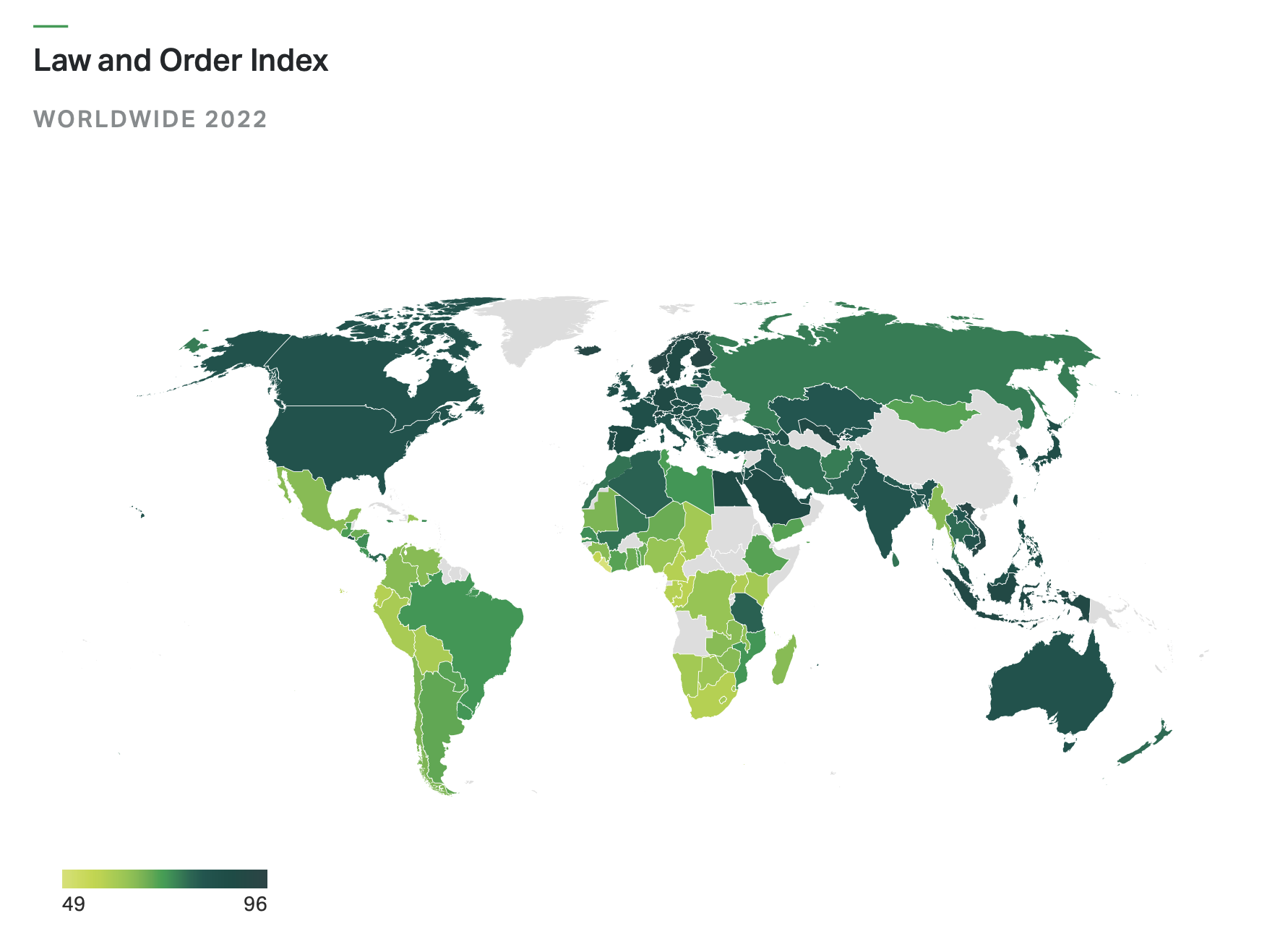
Regarding perceived safety on a daily basis, 71 percent of the world’s population reported feeling safe walking alone at night. Kuwait, Singapore and Tajikistan are among the safest countries, while Liberia, Myanmar and Lesotho rank among the least safe.
Compared to reported crime rates, about 12 percent of respondents reported theft of property, while 6 percent had experienced assault or robbery. Crime reached higher levels in Liberia and Sierra Leone, where more than half had experienced theft.
Analysis and trends
Sub-Saharan Africa and Latin America/Caribbean continue to face serious security problems, although Latin America has shown signs of improvement. In contrast, regions such as post-Soviet Eurasia have seen a steady increase in their scores, despite the ongoing conflict between Russia and Ukraine.
GALLUP’s study notes that in most economically developed countries and territories with a strong rule of law, the majority of residents feel safe walking alone at night. The same is true in countries where the population is subject to particularly strict state control. For example, in 2022, these impressions were reported at very high percentages in states such as Kuwait (96 percent), Singapore (95 percent), Tajikistan (93 percent), the United Arab Emirates (91 percent) or Saudi Arabia (90 percent).
In this picture, Italy ranks 38th (84 percent) tied with Armenia, Belgium, El Salvador and Hungary.
Perceived safety in Italy: data from ISTAT
The Gallup Report does not show the percentage of responses by individual question on perceived safety in Italy; however, it is possible to delve into the Italian scenario and the most interesting data through the most recent ISTAT surveys [2].
The perception of crime risk in our country averages 23.3 percent, rising 1.4 points from 2022.
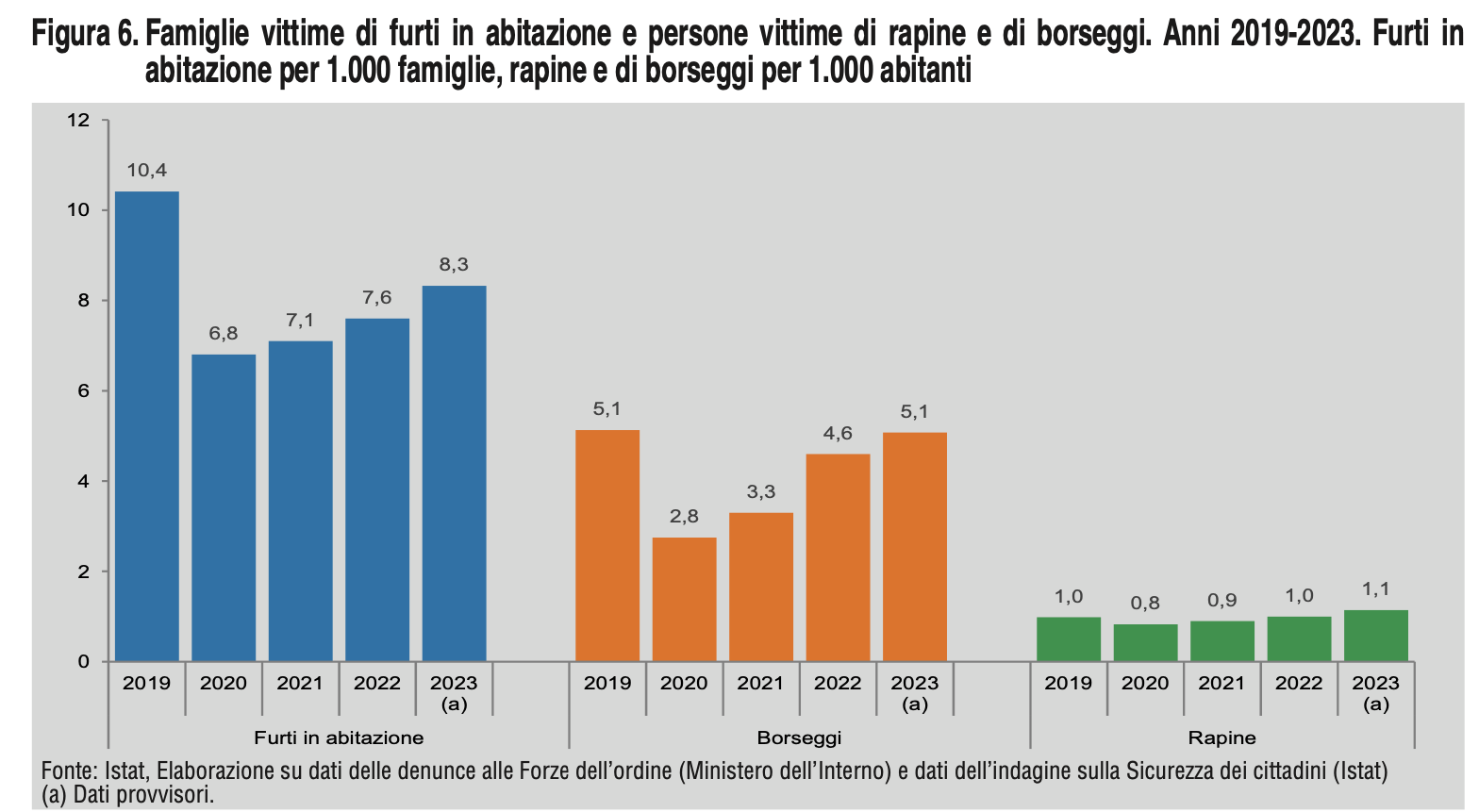
Predatory crimes (residential burglaries, burglaries, robberies) also increased, registering a steady upward trend after decreasing due to the particularity of the year 2020.
Only residential burglaries have not yet reached pre-pandemic levels (10.4‰ of households), standing at 8.3‰[3].
In 2023, the share of people aged 14 and older who say they are very or fairly safe when walking in the dark alone in the area where they live has grown in recent years to 62.0 percent; in 2019 that figure stood at 57.7 percent.
However, this figure is the result of the average between the responses of men and women, which differ widely: over 70% for men and just over 50% for women.
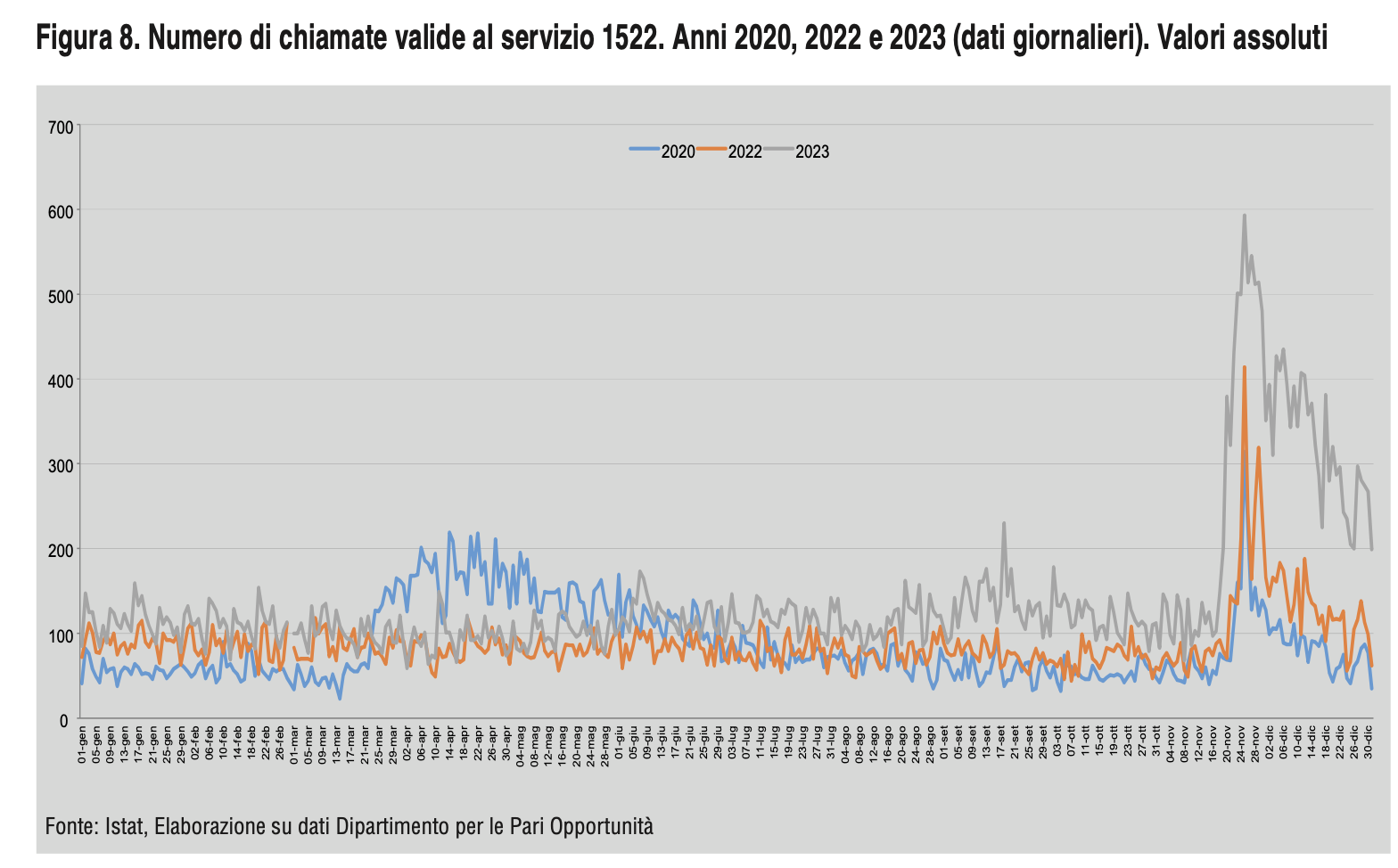
Finally, with respect to violence and stalking, the ISTAT study, among other data, highlights the growth in the use of the public utility number 1522. In 2023, valid calls grew by 59.5 percent, which is not indicative of the statistical trend of violence in Italy, but of the increased effectiveness of information campaigns, which reach more and more people from year to year.
The importance of raising awareness is underscored by a trend common to all years reported in the study: from late November there is an increase in daily calls, which double or triple compared to the rest of the year, probably corresponding with the information campaigns accompanying the International Day Against Violence Against Women on November 25.
References
[1] Download the report here. GALLUP results are based on nationally representative samples selected through probabilistic methods from the adult population, 15 years and older, in 141 countries and territories during 2022. The 2022 data were collected through telephone surveys or in-person interviews, with approximately 1,000 or more respondents in each country. The global estimate also includes 2021 data from China. [2] BES Report 2023, Chapter 7 – Security. [3] Crime data are the result of processing on data from complaints to law enforcement agencies (Ministry of the Interior) and the survey conducted by ISTAT on Citizen Security.
