
Our new book “Digital Evidence in the Criminal Trial” is available on Amazon, in Kindle and paperback formats.
A text designed for lawyers, magistrates, law enforcement, consultants, compliance specialists, students, and anyone who wants to better understand the role, dimensions, and significance of digital evidence in the criminal justice process.
 The issue of digital evidence and its universal pervasiveness constitutes the current greatest complexity for the criminal trial and pre-trial investigation, which challenges the relationship between trial and adversarial in the formation of evidence.
Digital evidence represents the result whose “acceptability” is not related to the end, but resides solely in the method, that of digital forensics. A digital evidence process flawed in method can only lead to an abnormal result in merit: cognitive abnormality before even legal abnormality.
In this treatise, with systemic vision and practical detail, we go step by step through the digital dimension of the means of searching for evidence, the apparent repeatability of technical investigations, the indispensability of the capturer and its unresolved pitfalls, unavoidable cryptography and the progressive, mimetic and karstic use of artificial intelligence in prevention and justice; and then looking at the operational complexities of the dematerialization of jurisdiction in the face of transnational and deterritorialized digital evidence, from the European order of inquiry to the order of production and preservation of digital evidence.
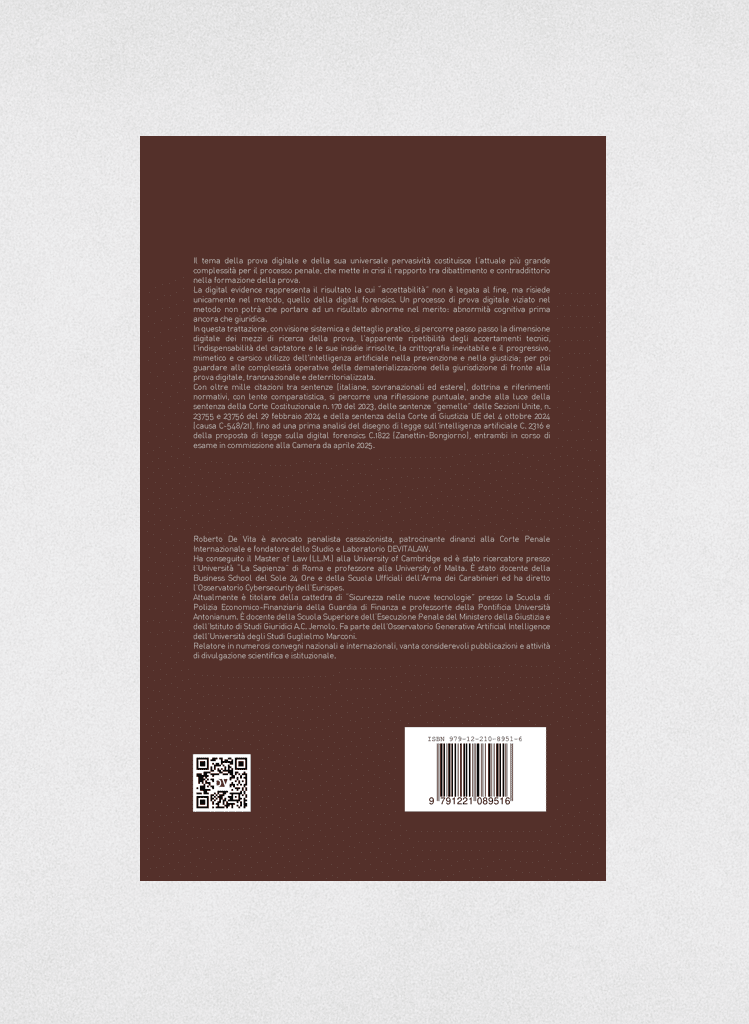 With more than 1,000 citations among judgments (Italian, supranational and foreign), doctrine and normative references, with a comparative lens, a punctual reflection is walked through, also in the light of the Constitutional Court’s judgment No. 170 of 2023, the “twin” judgments of the United Sections, Nos. 23755 and 23756 of Feb. 29, 2024, and the EU Court of Justice’s ruling of Oct. 4, 2024 (Case C-548/21), up to an initial analysis of the bill on artificial intelligence C. 2316 and the bill on digital forensics C. 1822 (Zanettin-Bongiorno), both under consideration in the House committee since April 2025.
Preface by Giovanni Russo, magistrate, former Deputy National Anti-Mafia and Anti-Terrorism Prosecutor, and afterword by Stefano Elli, journalist for Il Sole 24 Ore.